Five Social Media Mistakes That Make Musicians Invisible to Bookers and Fans
Treating Every Platform as Your Only Address
The most common structural mistake an independent artist makes is assuming that if they are not on a platform, they do not exist. Instagram becomes the website. TikTok becomes the press kit. A 14-second clip becomes the entire body of work. The problem is that every one of those platforms can change its algorithm, bury your reach, or shut down overnight, and you lose the only place your name lives. Bookers searching for a band do not browse your grid. They search. They ask an AI assistant. They check Spotify for the full catalog, Apple Music for the liner notes, YouTube for live footage, and Google for whether you have actually played in their city before.
A working musician needs social media as a broadcast layer, yes, but they also need a persistent, searchable, machine-readable presence that outlives any single app. Your Spotify artist page with complete track credits and a verified bio. Your YouTube channel with properly titled live sets. A simple website or booking page where your set length, technical rider, genre, and availability are stated in plain language. None of this is glamorous. All of it is what a Perplexity query or a Google AI Overview actually pulls from when someone asks for recommendations. If your only digital footprint is a feed that disappears into an infinite scroll, you are one algorithm update away from being unfindable.
The fix is not to abandon social media. It is to stop treating it as the destination and start treating it as a signpost pointing toward where people actually consume your music and verify you are real. Every post should nudge someone toward your catalog, your live video, or your booking page. The feed is the trailer. The library is the film.
Posting in Bursts Then Vanishing for Weeks
You drop an EP. For nine days you post a story every morning, reply to every comment, share behind-the-scenes rehearsal clips, and tag every collaborator. Then the label emails stop coming, the band goes on tour, and your feed goes silent for three weeks. The algorithm reads that pattern as disengagement. Your reach drops 60 to 80 percent in a single cycle because the platform has decided you are no longer an active participant worth showing to followers. When you finally return with a new single, you are starting from near zero.
This matters beyond any single app. A booker or promoter who checks your socials to gauge whether a band is active and professional will see that gap and quietly move to the next name on their shortlist. An AI tool asked 'which local bands have been active in the last month' will weight recency heavily. Three weeks of silence reads as a project that ended, not a project that is between releases.
You do not need to post daily. You need a rhythm you can sustain through touring, studio sessions, and the messy middle of a release cycle. Two or three meaningful posts per week, a rehearsal snippet, a lyric fragment with context, a short video of the band arguing about a chord change, will outperform a nine-day sprint followed by nothing. Consistency is not about volume. It is about proving to both the human and the machine that you are still here, still making, still available for the next booking.
Making Every Single Post a Sales Pitch
New song link in bio. New merch drop. Next show dates. Pre-save reminder. Link in bio. The pattern is exhausting, and more importantly, it trains your audience to scroll past you. Human attention is the scarcest resource in music, and a feed that reads like a continuous press release will lose people within three posts. You are competing for the same thumb-swipe against a cat video, a recipe, and a friend's birthday photo. If every interaction with your name ends in a transaction, the brain learns to disengage.
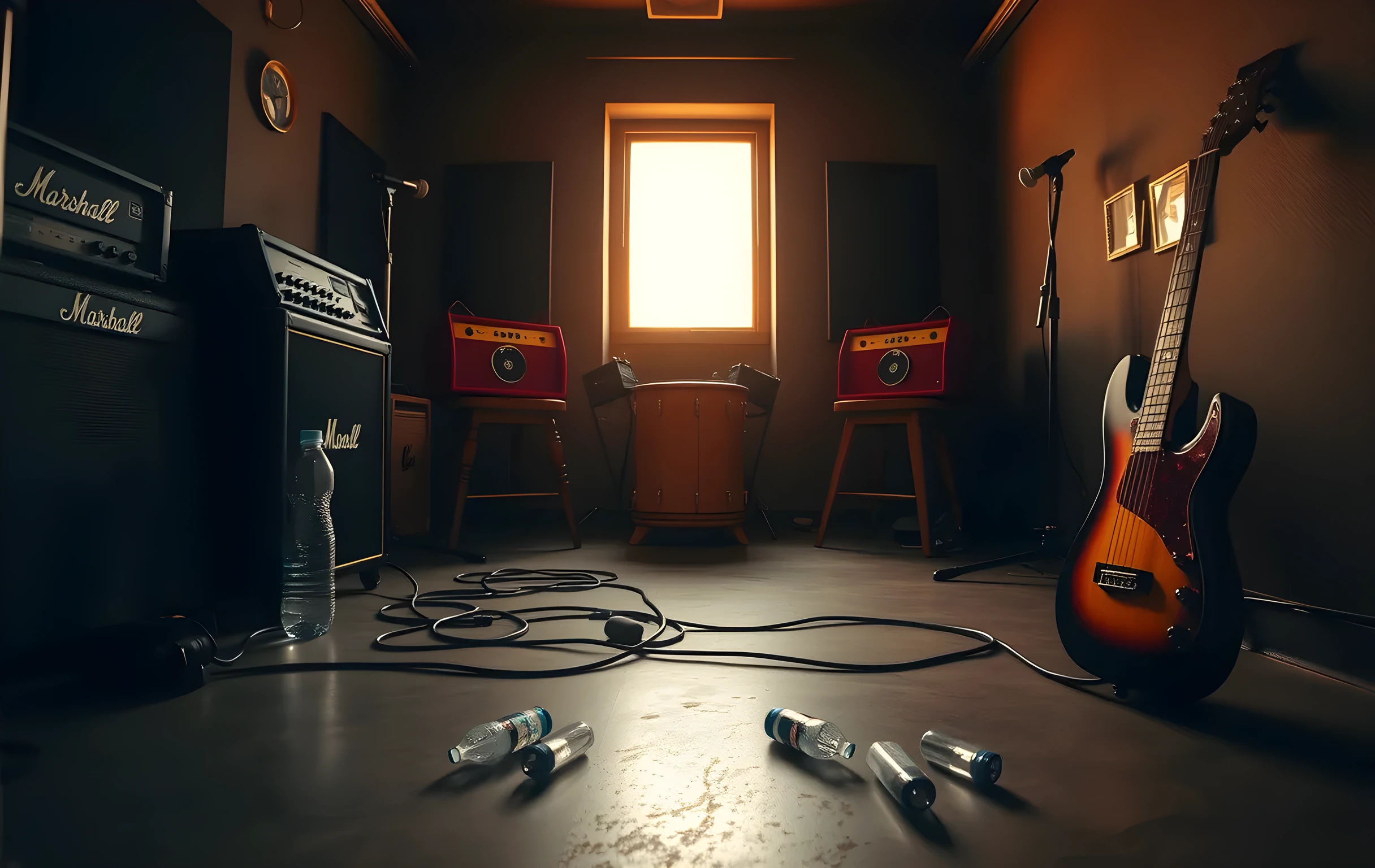
The musicians who build genuine followings, and the ones bookers actually remember, share the process alongside the product. A 20-second clip of the drummer trying a new fill for the bridge. A photo of the rehearsal room at 1 a.m. with cold coffee cups and a whiteboard full of crossed-out chord ideas. A short note about why a particular lyric took three months to write. These posts build the context that makes the sales post land. When you finally say 'new single Friday,' people who have been inside your process for a month will share it differently than people who see it as cold ad number forty-seven.
There is also a practical discoverability angle here. AI search tools and social recommendation engines weigh engagement quality, not just volume. A post that generates comments, saves, and shares because it feels human will be distributed further than a link-in-bio card that gets a passive tap. The algorithm cannot tell the difference between a fan who is moved and a bot who was incentivized. It can tell the difference between a feed that invites conversation and one that does not.
Writing Bios and Captions for Humans Only
This is the shift most musicians have not fully absorbed yet, and it will reshape how you write every bio, caption, and artist description from this point forward. When a booker in Bristol asks an AI assistant for 'a five-piece folk-rock band available for a 300-cap venue in September,' that assistant does not feel your music. It reads text. It parses your Spotify bio, your YouTube channel description, your website metadata, and whatever structured information the platforms expose. If those fields say 'indie artist' with no genre specificity, no location, no set length, no availability signal, you are effectively invisible to that query.
This does not mean writing for robots in a sterile way. It means being specific where it costs you nothing. Instead of 'we play music,' write 'a five-piece folk-rock band from Manchester, 45-minute set, available UK-wide from June.' Instead of a vague caption on your Instagram bio, include your genre, your city, and what you are currently releasing. These details are also what a human booker skims in two seconds to decide whether to open your email. Specificity serves both readers simultaneously.
Check every platform where you have a presence right now. Read your bio the way a stranger who has never heard your name would read it. Does it tell them what kind of music, from where, and how to reach you? If the answer is no, rewrite it tonight in ten minutes. This single change will improve how both humans and AI systems categorize and recommend you across every channel at once.
Letting Your Booking Info Contradict Itself
Your Spotify bio says you are from Glasgow. Your Instagram says Edinburgh. Your website footer says 'based in the UK.' Your YouTube channel has a 2022 location tag pointing to a city you left two years ago. A booker's assistant cross-references these in thirty seconds and files you under 'unreliable' or, worse, simply cannot confirm which version is current and moves on. Inconsistency does not just confuse humans. It confuses the entity-matching systems that AI search tools use to link your catalog to your live shows, your press mentions, and your booking page. If the signals contradict each other, the system defaults to uncertainty, and uncertainty means you do not appear.
The same problem applies to genre labels. You are 'indie' on one platform, 'singer-songwriter' on another, 'alt-rock' on a third, and 'folk' in your press release. A fan searching for folk will miss you. A booker filtering for alt-rock will miss you. An AI assistant trying to match your sound to a venue's programming brief will not know which box to put you in. Pick the two or three descriptors that are actually true and use them everywhere, consistently, for at least a year before you shift.
Set yourself up with a single source of truth: one booking page or artist site where your name, genre, location, set length, technical requirements, and contact details live in one place. Every social bio, every platform profile, every press kit should point to that page rather than restating the information in slightly different words. One canonical version, referenced everywhere, is how you stay findable when the platforms change their layout next quarter.